Audi Drives Virtual Reality Showroom with HTC Vive

http://fortune.com/2016/01/08/audi-showroom-uses-vr/?xid=soc_socialflow_facebook_FORTUNE

German automaker Audi revealed the future of its showrooms at CES this week, using the HTC Vive virtual reality headset to showcase a high-end experience that will debut in Q2.

Customers will use iPads to select any make or model and then customize every element of the car from exterior paint to wheels to engine type to interior seats. Then they go to a 16-by-16-foot area and put on an HTC (HTC) Vive headset and Bang & Olufsen headphones, and their customized vehicle appears in virtual reality.

The customer can move around the exterior of the vehicle, open the trunk and doors, check out the headlights and tail lights, look underneath the hood, and even get inside the vehicle and sit in the driver’s seat, says Thomas Zuchtriegel, project manager with Audi Digital Retail Solutions.

“Virtual reality wasn’t convenient on a low-budget level to bring to customers until recently, it was always heavy and not scalable or portable,” Zuchtriegel says.

That all changed with the introduction of the Oculus Rift, which was the first headset the team at Audi used to develop this experience. Audi, a subsidiary of Volkswagen Group, debuted a sit-down Oculus Rift version of this experience, which doesn’t allow the user to walk around the vehicle, at the Detroit Auto Show last year. Three dealerships in Brazil have already tested the experience.

Zuchtriegel says Audi will use both versions of the experience beginning this year. The HTC Vive version will be used at flagship locations like the Audi City London store, while the Oculus Rift version will be implemented at other dealerships.

WATCHCars are the stars at CES 2016

“It’s all about using technology to empower the dealer and enhance the customer experience,” Zuchtriegel says.

The virtual reality system runs on a high-end graphics engine developed by ZeroLight and powered by high-end HP (HPE, +0.25%) PC workstations powered by two Nvidia graphics cards. Nvidia (NVDA, +2.48%) was an early partner on this project.

The processing power of the system allows 3D models of the vehicles to appear in virtual reality at a rate of 90 frames per second with nearly zero latency, which means customers see exact replicas of what they’re buying.

“It has to be absolutely perfect to convince the customer that this car is there,” Zuchtriegel says.

In addition to offering every single make and model that Audi currently has, Zuchtriegel says the latest vehicle data configurations will be added as new models are introduced. The system connects directly to Audi’s IT network.

SIGN UPGet Data SheetFortune’s  daily newsletter about the business of technology.

“We are always interested in new technology,” Zuchtriegel says. “We were the first movers in virtual reality and we started development of the system way ahead of the competition.”

As for getting an actual virtual reality test drive, “that’s a very interesting topic,” says Zuchtriegel. An active driving experience would require a lot of additional technology, including a working steering wheel and pedals. That type of simulation experience is likely much farther down the line, whereas a passive prerecorded driving experience is something that could be possible in the not-so-distant future.

A sweatshirt massage is better than no massage at all

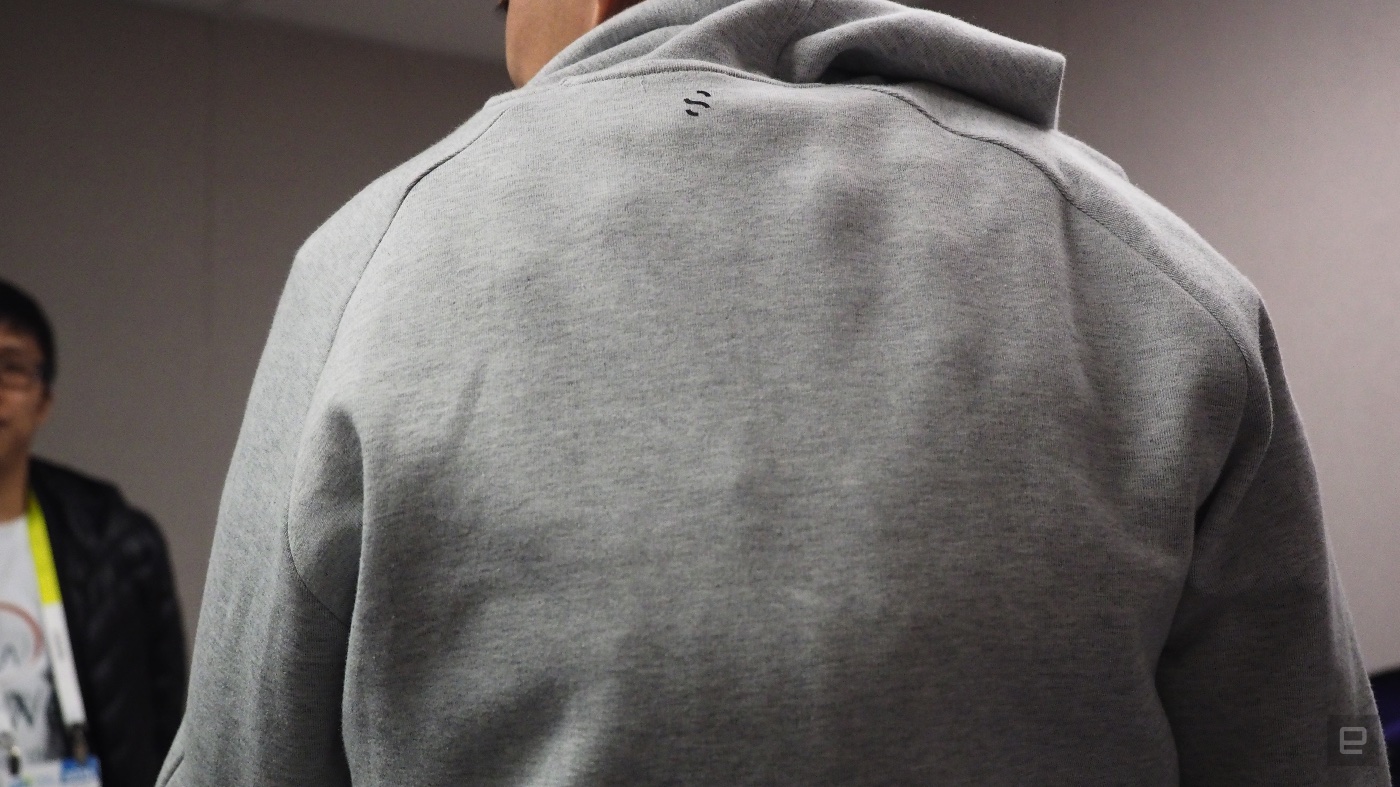
I like massages. Who doesn’t? But what if you could get a massage while you worked? Stood up or sat down anywhere. In your home, the office, or in the car? That’s the premise of the AiraWear, a massage vest that embeds into (at the moment) a zip-up hoodie. I’m typing part of this article while my shoulders are being gently teased by two firm foam points, backed by air cushions that inflate and deflate. I just cranked the power to max and I’m feeling pretty good.

Gallery: Airawear massage vest at CES 2016 | 10 Photos

  • +6
X

It’s not the first massage wearable we’ve seen, but it’s a surprisingly effective one. Six inflatable pads have stiffened foam points attached to them: these are positioned in a way to ease muscle knots and generally feel nice. The vest also inflates in strips running vertically along your back, which adds a body compression effect, which keeps those expanding pads in place and, according to parent company Tware, strengthens mental focus. (The company has worked on stress- and pain-relieving wearables for a few years.) Of course, it looks like you have a bunch of lumps growing out of your back, but that’s the price you pay for a massage at your desk. The massage effect is notably stronger when you’re sat in a chair, which helps push the massage pads into your back.

Targeted massages can be directed to the upper and lower back, as well as the shoulders, with a relax mode that attacks all three and a sleep option that’s altogether gentler. The current prototype lasts for three hours of massage, with a rechargeable battery that holsters in the side of the vest. It can be attached to zip-up clothes: the company has made several items for both men and women. The vest also performs a secondary function monitoring your posture. A little boxy stickman will reproduce what you’re doing in real life and tell you when you should sit up / stand up straight. The company will launch a crowdfunding campaign next month, and plans to fulfill preorders in Fall 2016. How much? Expect it to fall just short of $250 — and a cheeky discount if you decide to back the project early.

Source: Airawear
Mat once failed an audition to be the Milkybar Kid: an advert creation that pushed white chocolate on gluttonous British children. Two decades later, having repressed that early rejection, he completed a three-year teaching stint in Japan with help from world-class internet and a raft of bizarre DS titles. After a few weeks back in the UK, he’s recently returned to Japan, heading up our coverage of a country that’s obsessed with technology — often in very unusual ways.

Nissan Makes Terrifying Self-Parking Office Chairs

http://jalopnik.com/nissans-demonstrates-autonomous-technology-with-terrify-1759519992

The engineers at Nissan are excited about autonomous driving technology. So excited in fact, they pulled themselves away from working on actual cars to demonstrate how smart they were with self-parking office chairs. Office chairs that terrifyingly move around when you leave the room.

I’m admittedly a little confused. I bought my office chair for too much money at Staples, in pieces, in a box. I brought it home, assembled it my damn self, and put it at my desk; a spot it happily hasn’t moved from in over six months. I’m quite satisfied knowing it is dead inside, and not going to suddenly drag me away into the hell Nissan’s autonomous seats spawn from.

Nissan apparently has different plans for its office chairs.

NOPE. Tell me that isn’t something straight out of Paranormal Activity. Here’s an idea: tell your employees to not be inconsiderate and lazy.

The system uses at least four cameras in the room to analyze the 3D space, communicating and informing the chairs how to navigate the room and tuck themselves back under the desk. First we took cursive out of third grade, and now we wont even be teaching Kindergartners to push in their chairs. What little monsters they’ll become.

The chairs were developed to show off Nissan’s upcoming autonomous automotive technology. Technology they plan to provide in either semi-autonomous or fully-autonomous capacity in at least ten production models by 2020. You want to know how other companies would approach showing off autonomous automotive technology? Making an updated autonomous automobile to demonstrate (and not the Leaf from three years ago).

Under Armour’s new innovation lab features robots that make sneakers — take a look inside

http://www.businessinsider.com/under-armours-new-innovation-lab-features-robots-that-make-sneakers-and-we-went-inside-2016-6

The process of making athletic shoes and clothing has changed very little in the last half-century. Apart from industrial-sized machines that speed up production, many factories’ operations look pretty similar.

Under Armour wants to reinvent the process in its giant design and manufacturing test center, which opened June 28. Called the Lighthouse, the 140,000-square-foot space will act as an extension of UA’s Baltimore headquarters.

The goal of the new lab is to re-think how sneakers and athletic apparel are made, Under Armour’s Head of Innovation, Kevin Haley, tells Tech Insider.

Tech Insider got an exclusive look inside the lab, which features a massive 3D body scanner and robots that make shoes. Check it out.

giphy (64)

View As: One Page Slides


The Lighthouse is located inside a former garage in Port Covington, an area south of Baltimore’s city center. It’s a 10-minute drive from the main campus.

The Lighthouse is located inside a former garage in Port Covington, an area south of Baltimore's city center. It's a 10-minute drive from the main campus.

Leanna Garfield/Tech Insider

The space is the first major addition to UA’s planned expansion in Baltimore. Eventually, the new campus is expected to house over 10,000 employees — the multibillion-dollar plan calls for three skyscrapers and a stadium.

The space is the first major addition to UA's planned expansion in Baltimore. Eventually, the new campus is expected to house over 10,000 employees — the multibillion-dollar plan calls for three skyscrapers and a stadium.

Lighthouse director Adam Bayer opens the doors to the warehouse.Leanna Garfield/Tech Insider

As UA’s innovation hub, the Lighthouse will be the place where new products get tested. The idea behind the facility is to make the production process faster and more efficient, the Lighthouse’s director, Adam Bayer, tells Tech Insider.

As UA's innovation hub, the Lighthouse will be the place where new products get tested. The idea behind the facility is to make the production process faster and more efficient, the Lighthouse's director, Adam Bayer, tells Tech Insider.

Leanna Garfield/Tech Insider

It’s full of mind-blowing technology, like this machine that molds the toes of sneakers.

It's full of mind-blowing technology, like this machine that molds the toes of sneakers.

Leanna Garfield/Tech Insider

A lighting-fast laser cutter called the Lectra is programmed to slice fabric in a way that generates the least amount of waste possible.

A lighting-fast laser cutter called the Lectra is programmed to slice fabric in a way that generates the least amount of waste possible.

Leanna Garfield/Tech Insider

Once a worker puts the pattern in the system, the computer figures out the optimal way to slice it.

It can cut through up to 50 sheets of fabric at once.

It can cut through up to 50 sheets of fabric at once.

Leanna Garfield/Tech Insider

Here it is in action:

ua

On the left side of the warehouse, there’s a robot programmed to apply glue to soles in a matter of seconds. The soles then go to another machine that cements them to body of the shoes.

ua

The machine can apply glue to 2,400 pairs of shoes in eight hours — a task that would normally require a 200-person production line. The bot only needs one person to man it.

The machine can apply glue to 2,400 pairs of shoes in eight hours — a task that would normally require a 200-person production line. The bot only needs one person to man it.

Leanna Garfield/Tech Insider

Another machine (pictured below) can mold ultra-light soles from a special dense foam, called EVA.

Another machine (pictured below) can mold ultra-light soles from a special dense foam, called EVA.

Leanna Garfield/Tech Insider

To bond the soles to the body of the shoe, UA uses heat instead of glue, since glue can add weight to sneakers.

To bond the soles to the body of the shoe, UA uses heat instead of glue, since glue can add weight to sneakers.

Leanna Garfield/Tech Insider

The machine can make cool patterns on the bottom of the soles.

The machine can make cool patterns on the bottom of the soles.

Leanna Garfield/Tech Insider

The Lighthouse also has a massive 3D body scanner that takes photos of athletes in action. (Most traditional scanners only work when you’re standing still.) Using 54 cameras that shoot seven frames per second, the scanner makes 3D avatars.

giphy (64)

Designers can use the avatars to study every crevice of an athlete’s body and make custom athletic wear just for them.

Designers can use the avatars to study every crevice of an athlete's body and make custom athletic wear just for them.

Leanna Garfield/Tech Insider

For example, using 3D scans of tennis star Sloane Stephens, UA’s designers can look at how a shirt will drape when she swings her racket. Since her body’s shape changes based on how much she’s training, the team can anticipate how Stephen’s clothing will fit and adjust accordingly.

For example, using 3D scans of tennis star Sloane Stephens, UA's designers can look at how a shirt will drape when she swings her racket. Since her body's shape changes based on how much she's training, the team can anticipate how Stephen's clothing will fit and adjust accordingly.

Leanna Garfield/Tech Insider

Lighthouse employees are constantly working to improve the design process. Pictured below is a sewing machine that can temporarily bind fabric without making a single stitch.

Lighthouse employees are constantly working to improve the design process. Pictured below is a sewing machine that can temporarily bind fabric without making a single stitch.

Leanna Garfield/Tech Insider

This gives UA the freedom to try out different designs without wasting fabric or thread. If the team wants to try something different, they can easily pull the fabric apart and start over.

This gives UA the freedom to try out different designs without wasting fabric or thread. If the team wants to try something different, they can easily pull the fabric apart and start over.

Leanna Garfield/Tech Insider

Instead of a traditional elastic waistband for pants, which can pinch the skin after a few hours, the UA team is experimenting with using the thin tape pictured below.

Instead of a traditional elastic waistband for pants, which can pinch the skin after a few hours, the UA team is experimenting with using the thin tape pictured below.

Leanna Garfield/Tech Insider

The workers just press it to a piece of fabric, pull off the backing, and the fabric magically becomes stretchy.

The workers just press it to a piece of fabric, pull off the backing, and the fabric magically becomes stretchy.

Leanna Garfield/Tech Insider

The Lighthouse team also aims to improve the process of 3D-printing shoes. In July, UA will premiere a new line of 3D-printed shoes called the Architech.

The Lighthouse team also aims to improve the process of 3D-printing shoes. In July, UA will premiere a new line of 3D-printed shoes called the Architech.

Early renderings of the Architech shoe.Leanna Garfield/Tech Insider

UA’s 3D printer can sculpt the Architech sneakers from powder in under 24 hours. It builds each layer of the shoe by heating the powder, which solidifies it.

UA's 3D printer can sculpt the Architech sneakers from powder in under 24 hours. It builds each layer of the shoe by heating the powder, which solidifies it.

An Architech sneaker.Leanna Garfield/Tech Insider

UA hopes that by putting the best designers, developers, and engineers all in one room, the brand can improve how it makes its products, Haley says.

UA hopes that by putting the best designers, developers, and engineers all in one room, the brand can improve how it makes its products, Haley says.

Leanna Garfield/Tech Insider

The company is committed to designing and manufacturing the next generation of athletic apparel.

The company is committed to designing and manufacturing the next generation of athletic apparel.

Can Neuroscience Unlock the Luxury Mind?

Can Neuroscience Unlock the Luxury Mind?

LONDON, United Kingdom — Shopping for fashion can be a ride on an emotional carousel: the thrill of the chase; arduous hunting through stores and websites; the rush when you finally find what you’re looking for. Your heart races. Your skin tingles. You’re elated — for a few seconds, euphoric.

Most of us would claim we make rational decisions when shopping. And for much of the twentieth century, mainstream economists tended to agree, believing that decision-making was rooted in a careful calculation of costs and rewards.

But newer theories have questioned this belief. French sociologist Pierre Bourdieu argued that social agents do not make decisions according to rational criteria. Business consultant and author Jim Nightingale claimed, “we simply decide without thinking much about the decision process.” Indeed, according to modern neuroscience — the study of the nervous system — even in rational decision-making, emotions have been proven to play a major role.

The market for fashion and luxury exemplifies this paradox. Fashion brands are finely tuned to conjure emotions that override our rational decision-making functions and entice us to buy things that we desire, but know we do not strictly need.

Can neuroscience be harnessed by brands to better understand what goes through our brains when we shop — and drive sales?

By measuring how the brain responds to different stimuli, the field of consumer neuroscience aims to paint a more accurate picture of human decision-making than traditional research methods like focus groups and surveys. “People from focus groups will say things that they think are socially acceptable or they’ll go along with the rest of the group,” said Dr David Lewis, a neuropsychologist and the chairman of market research firm MindLab international “Neuroscience tries to get underneath their conscious appraisal.”

In a 2014 study by Copenhagen Business School’s department of marketing, subjects were shown luxury brand names like Gucci or high-street names like H&M, before subsequently being shown an item of clothing. “Even when we show people those brand names for less than 50 milliseconds, there is an emotional response, such as pupil dilation or changes in brain responses,” said Dr Thomas Zoëga Ramsøy, co-author of the report. “People’s implicit expectation when you see a high fashion brand leads to a whole cascade of emotional responses when you see the product itself.”

Other studies confirm that our brains react more to products that we think are valuable. “If you have two pairs of slacks, for example, and one pair looks less valuable than the other pair, the brain should compute more reward when obtaining the more valuable thing,” said Dr Dar Meshi, a neuroscience research fellow at Freie Universität Berlin.

Neuroscience has been used to study everything from sea slugs to stress. But over the last fifteen years, its commercial application has grown, with the promise of helping brands to stand out in a cluttered marketplace, by designing products and marketing that appeal to our emotional, unconscious responses.

The first ‘neuromarketing’ firms appeared in the late 1980s and, in 2002, Professor Ale Smidts of the Rotterdam School of Management officially coined the term. By 2012, there were 250 companies specialising in ‘neurometrics,’ most using functional magnetic resonance imaging (fMRI) scans and electroencephalography (EEG), a method in which electrodes are attached to a subject’s head, in order to track the unconscious, split-second responses of the brain.

“If someone was looking at a new fashion item and they had an increase in blood flow to the hippocampus, which is associated with memory, it might induce that this item was going to be memorable, or they would recall it easily if it was mentioned to them,” explained Dr Lewis. According to Dr Lewis, “most major brands” across sectors like food and drink and travel are using some form of neuromarketing, while a few are going so far as to build in-house neuroscience laboratories.

The fashion and luxury industry, however, has traditionally been slow to leverage the power of consumer research, including neuroscience. Instead, luxury fashion brands have historically hired human specialists with highly attuned sensitivities and high EQs (Emotional Quotient, a measure of emotional intelligence) to understand what turns people on and design products, stores and marketing that will successfully seduce customers.

“Fashion has perhaps been a little slower than other industries to explore the potential of neuroscience, which is odd considering it’s an industry driven by human passion and desire,” said Jonathan Openshaw, global editor of LS:N Global, the trend and consumer insight network of business consultancy The Future Laboratory. However, Openshaw believes it is “inevitable” that fashion companies will begin to harness neuroscience.

A few are already on board. In a study for fashion retail chain T.J.Maxx, Mindlab International used EEG to track customers’ brain activity as they shopped in a T.J.Maxx store. “Their USP is that they put designer label products at very low costs among much more utilitarian items,” explained Dr Lewis. “When people found one of these products, we saw a significant increase in brain activity associated with surprise, delight and reward.” Although the brain activity could have been indicative of other, more negative emotions, in the context of this experiment, the positive emotions identified are more probable. Armed with this information, T.J. Maxx could design its store layout to maximise this ‘treasure hunt’ effect and attempt to trigger more moments of positive, purchase-inducing feelings.

Neurensics is a European neuroeconomic research firm that counts Cosmopolitan magazine amongst its clients. In one study, the firm used fMRI scans to test the effects of three magazine covers — each with a different coloured background and positioning of text — on parts of the brain. “One of the covers scored a lot better than the other two, and we predicted that that cover would sell more than the other two,”said Dr Walter Limpens, research manager at Neurensics. “We didn’t know why it scored better. We only saw that it activated the brain more.”

At the moment, concerns remain about the accuracy of such insights and, according to Dr Ramsøy, the field has fallen prey to “hype-cycles” due to “a lot of overpromising and under-delivering” from neuromarketing companies lacking “scientific credibility.”

Certainly, neuroscience faces technological hurdles. fMRI scanning is expensive and time-intensive — a study of less than 50 people can take up to a year — and requires subjects to be lying down and motionless, making experiences such as trying on clothing impossible to survey. EEG tracks electrical activity in the brain through an electrode-studded cap. This allows for more movement, but can only pick up activity close to the surface of the scalp. “The ‘reward centre’is at the centre of the brain, deep down there. So you can’t measure this reward activity using EEG,” said Dr Meshi, but added: “I think you’ll see an explosion of people using [neuroscience] when the technology becomes less cumbersome.”

Some companies are hesitant to reveal their neuroscience research due to concerns about how consumers would react to the idea of companies subliminally influencing their shopping choices by tapping their private, unconscious desires. Yet consumer neuroscientists like Dr Marci say the “emotion” they study is the part of the brain that “tags information for relevance,” as opposed to specific feelings or moods.

“You don’t know what people are thinking, but you observe how their brains are responding,” said Dr Lewis. “You can’t tell specific emotions, but you can tell the difference between avoidance and attraction.”

As e-commerce grows, shopping behaviour shifts away from the more frictionful process of visiting a store towards a world of instantly shoppable products. Online, shoppers can turn their impulses into purchases faster than ever before — could neuroscience reveal what drives these split-second decisions? “We have the ability to purchase more impulsively than ever,” said Dr Marci of the rise of online shopping. “The intuitive self, the impulsive self, the non-rational self is going to have even more of a driver.”

“Digital shopping means we are relying less on the rational response to a product, and more on the immediate emotional response we have when we see it,” agreed Dr Ramsøy. “As companies start seeing that the way people make up their minds is not influenced by their conscious minds as much, they start tailoring their communication strategy in a very different way.”

The advent of more sophisticated in-store technologies and wearable tech could also see neuroscience move outside of the lab and onto our bodies. Some neuromarketers also study ‘biometric responses,’ including pulse rate, eye-tracking and facial expression. Currently, companies track data such as where we click on a website, how long we view webpages for, and what goes in our shopping cart. If we were shopping on an Apple Watch or wearing a smartband, could they track our biometric responses too, to find out which products make our heart race, or our temperatures rise?

“Technology already allows us to do that, but you then run into ethical questions,” said Dr Ramsøy. All of the neuromarketing companies interviewed stated that they only collect such data in controlled surveys, conducted with participants’ consent.

Added Dr Marci: “If there was a force on the planet that influences what you wear and what you buy, wouldn’t you want to understand that?”

Retail Lessons from Pinterest

Retail Lessons from Pinterest

When Pinterest launched in 2010 they were an invite only social media site which quickly grew a lot of buzz. They are now valued at $5 billion.

At first glance, Pinterest is essentially a digital scrap-booking site. A place where users collect recipes and outfits they like. Where they plan for dream vacations and weddings. But with 70 million users, Pinterest is providing a note-worthy user experience, with lessons for other businesses. Pinterest is a social media site, not a retail location, but there are retail lessons to be gained from their tactics.

Keeping Customers in Your Store

Pinterest prioritizes keeping users on their site. Pinterest has announced that in 2015 they will add a “buy” button. The buy button will allow customers to purchase items without leaving the site. They also allow for iOS users to download apps through their App Store, where they feature curated boards like “Fashion Apps” and “Staff Picks”. Like Pinterest adding features to keep users on their site, Retailers need to make an effort to keep customers in their store.

There is a relationship between the amount of time a customer spends in a retail store, and their likelihood of making a purchase. According to Paco Underhill, in his book “Why We Buy“, customers who make a purchase spend three to four times as long in a store as those who do not make a purchase. It makes sense then, for retailers to try to keep customers in the store.

Applying this to Retail

Retailers need to make it as easy as possible for customers to complete a purchase before they leave. They can achieve this by offering price matching for customers who are shopping on a mobile device while looking at items in a store. They can also provide a way for customers who order items in a different size or color from what is available in the store, and have it shipped directly to them.

Using Technology to Delight Customers

The success of Pinterest comes from giving a tech makeover to an old concept. Pinterest takes the practice of cutting pictures out of magazines, and updates it for the web. Users create virtual “boards”, a well organized collection of curated items with helpful links.

Pinterest also appeals to the hunter/gather instinct of shoppers. A tool for window shoppers and those with purchase intention alike.  The ability to use Pinterest as a search engine appeals to users who are hunting for something specific. While the casual browser can gather pins by following their friends or looking at specific categories.

Applying this to Retail

Coming out the recession, retail store may have missed years of technology upgrades. We are now seeing a surge in retailers using technology to appeal to their customers. Time Warner Cable uses their Experience Stores to shed their former, DMV-like, image. Retailers are using ibeacons instead of signs to guide customers around their stores. They are trading in traditional mirrors for digital ones. Even fitting rooms are getting a high-tech makeover. The tech used must enhance the user experience in some way.

‘In-store GPS’ system for Carrefour developed by Philips

‘In-store GPS’ system for Carrefour developed by Philips

21st May 2015

Supermarket giant Carrefour has employed a location-based navigation and marketing system, using connected lighting from Philips, marking the first full scale installation of the system.

Functioning like an indoor GPS system, the system transmits location information from light fittings via a mobile phone app. It is accurate to distances of less than a metre, allowing the system to guide shoppers to individual fixtures and products within a store.

As part of a refurbishment of Carrefour’s Lille hypermarket has seen the previous fluorescent lighting replaced with 2.5km of energy efficient Philips LED lighting, which uses light to transmit a location signal to smartphones.

The Philips system enables Carrefour to provide new services such as helping shoppers to navigate and find products and promotions across the 7,800 sq m store. In addition, the LED lighting will reduce by 50% the total lighting-based electricity consumption of the hypermarket.

“We are always on the lookout for innovations to facilitate customers’ navigation in our stores and meet consumers’ expectations,” says Carrefour director of commercial models and innovation for hypermarkets in France Céline Martin. “Thanks to this new application, which uses Philips technology, we are now able to provide our customers at the EuraLille Carrefour with a new service, enabling them to quickly search and locate their preferred promotions or detect all the promotions around them when in-store.”

The indoor positioning system consists of LED fixtures, a cloud based location database and a Philips software development kit, on which customers can build their own mobile interaction platform.

The system in the Lille hypermarket comprises 800 linear LED fixtures that use patented Philips VLC (Visible Light Communication) technology to transmit a unique code through light that is undetectable to the human eye but can be detected by a smartphone camera.

The system does not read data on the smartphones it interacts with. Each light fixture transmits a one-way stream of data, and the app can be turned off at any time.

Philips software and location database has been integrated into Carrefour’s “Promo C’ou” mobile app, created by Think&Go.

“We are leading the way with connected lighting for retail with Carrefour,” says Philips Lighting head of LED-based indoor positioning Gerben van der Lugt. “Our connected lighting system has the potential to transform shopping into a more interactive and personalized experience. At the same time it will enable retailers to differentiate themselves, enhance customer loyalty and provide new services to shoppers.”

Design a site like this with WordPress.com
Get started